Core service
Foundation Repair in Houston, TX
Evaluation, stabilization and repair for residential foundations across Greater Houston — slab-on-grade and pier-and-beam alike.
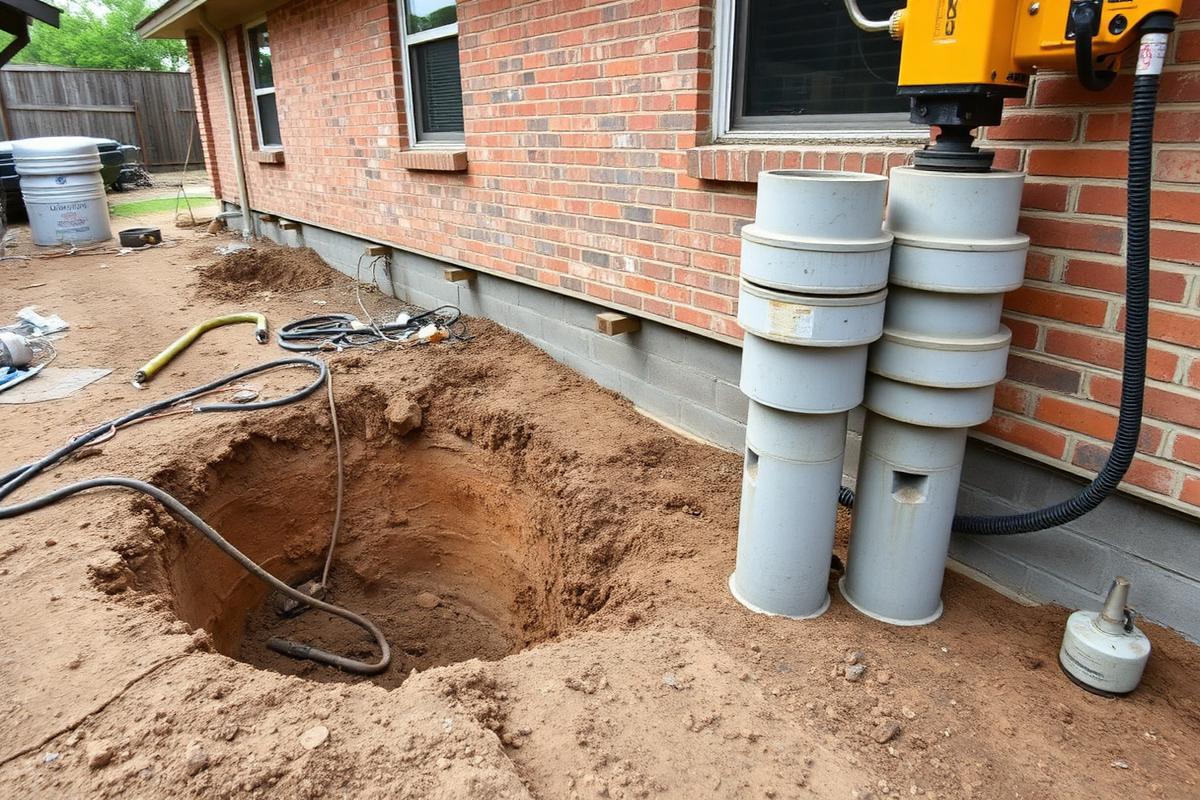
What foundation repair actually addresses
Residential foundation repair is the work of returning support to a structure that is no longer being held evenly by the soil beneath it. In practice that means three related things: identifying where the foundation has moved, restoring support in those areas, and — where it makes sense — bringing the affected section back toward its original elevation.
Greater Houston contains extensive clay-rich soils that can expand when wet and shrink during prolonged dry periods. These moisture changes can contribute to differential foundation movement depending on the property, drainage, foundation type, and site conditions.
Settlement and structural movement
Settlement is downward movement of part of a foundation as the soil supporting it loses volume or bearing capacity. In Houston that is most often tied to soil drying and shrinking, though washout and poorly compacted fill also occur.
What matters structurally is the difference between one part of the house and another. A uniform drop of half an inch across an entire slab is rarely visible. Half an inch across ten feet produces cracked brick, doors that will not latch and sloping floors.
Leveling vs. stabilization
These are different objectives and it is worth being clear about which one applies. Leveling raises a settled area back toward its intended elevation. Stabilization holds the current position and stops further movement. Full recovery of the original elevation is not always achievable or advisable — lifting too aggressively can create new cracking.
Repair methods
Most residential structural repair in this market uses foundation piers installed beneath the foundation to transfer load to deeper, more stable material. Pressed concrete piers, steel piers and other engineered support systems each have appropriate applications depending on soil profile, load, depth to bearing and access.
Pier-and-beam homes are a different scope entirely — the work happens in the crawl space and involves interior supports, beams and joists. See pier and beam foundation repair.
Not every issue is structural. Where standing water or grading is contributing, drainage correction may be part of the plan.
Why evaluation comes first
A repair system chosen before the house has been measured is a guess. Elevation readings across the floor plan, the pattern of visible damage, the age and type of construction, drainage behavior and whether plumbing has been ruled out all change the recommendation. That is the purpose of the free foundation inspection.
Typical scope elements
Elevation survey
Floor readings across the plan establish how much differential movement exists and where.
Pier placement plan
Spacing and count are driven by load, wall lines and the shape of the settlement.
Lift and support
Controlled lifting where appropriate, followed by permanent support at the new position.
Site restoration
Backfill, sod or concrete restoration at access points is typically included in the scope.
Foundation repair questions
Does every foundation problem need piers?
No. Some homes show cosmetic cracking with no measurable elevation difference, and some issues trace back to drainage or a plumbing leak rather than structural settlement. Piers are one solution among several and should follow a finding, not precede it.
Can foundation repair be done in stages?
Sometimes. If movement is concentrated in one section, work can be limited to that area. Whether a partial scope is appropriate depends on the elevation pattern across the whole structure.
Will repair close all the cracks in my walls?
Lifting a settled section often closes cracks partially, but drywall, tape and mortar do not always return to their original position. Cosmetic restoration is usually handled separately after the structural work is complete.
Free Foundation Inspection
Tell us what you are seeing at the property.
Get a clear read on your foundation
An on-site evaluation tells you whether the movement is active, how far it has gone, and what the realistic repair options are.