Water management
Foundation Drainage Solutions in Houston
Houston gets a great deal of rain onto very flat ground. Where that water ends up around a house has a direct effect on how consistently the soil supporting the foundation behaves.
Why drainage matters here
Foundation movement in this region is largely a moisture story. Clay-rich soils change volume as their water content changes. When the moisture around a house is consistent, the soil behaves consistently. When one side of the house stays wet while another dries out, the two sides can behave differently — and the difference is what a structure feels.
Drainage is the most controllable input in that equation. It will not undo movement that has already happened, but it addresses one of the conditions that contributes to it.
Grading around the foundation
Soil should fall away from the house so water moves out rather than collecting at the slab edge. Over time, settling flower beds, added mulch, new patios and landscaping changes often reverse that slope without anyone noticing. Regrading the first several feet around the perimeter is often the highest-value correction available.
Standing water
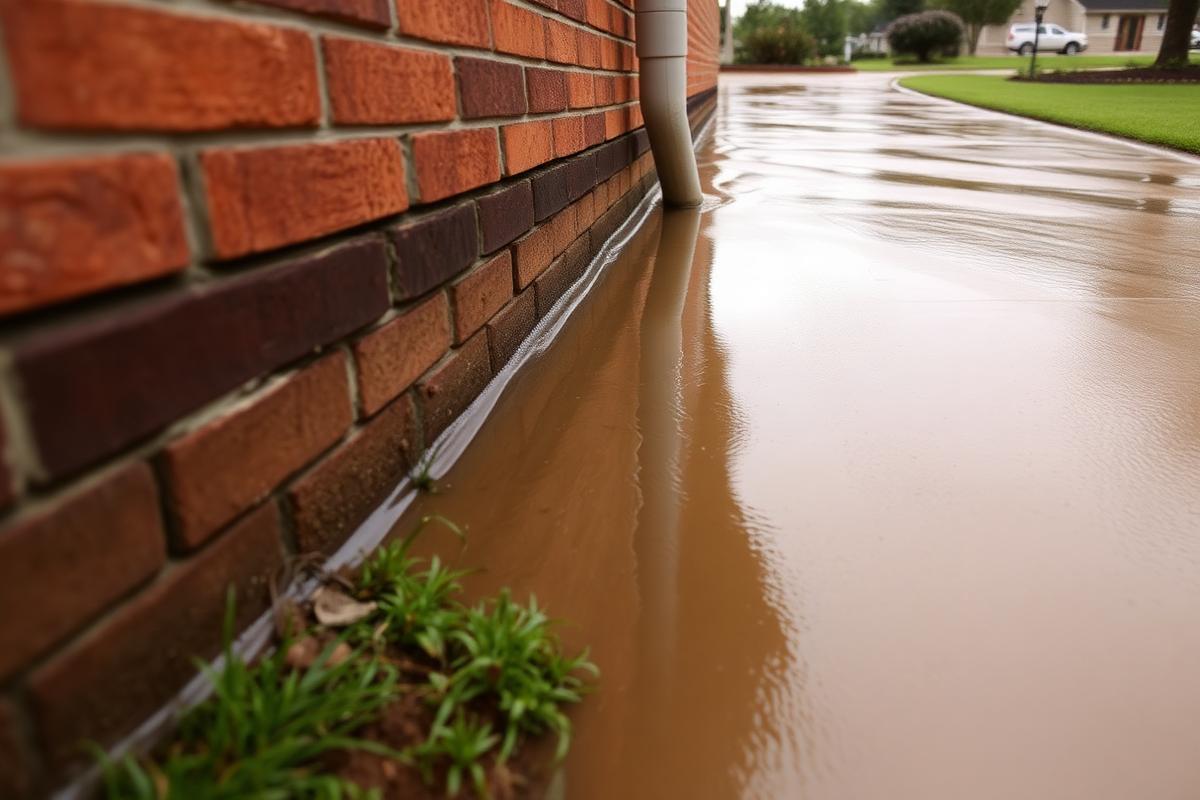
On the flat lots common across the Houston metro, water that has nowhere to go simply stays. A low spot that holds water for a day or two after a storm keeps the soil beneath it near saturation while the rest of the perimeter dries. Surface drains, swales or subsurface drainage can move that water to an outlet.
Gutters and runoff
A roof concentrates a large volume of water into a few discharge points. Downspouts that empty right against the foundation deliver repeated heavy soaking to a small area. Extending discharge well away from the house is inexpensive and effective. Missing or overflowing gutters have the same effect along an entire roof edge.
Moisture imbalance and soil movement
Irrigation heads aimed at the slab, a shaded side that never dries, large trees drawing moisture from one corner during a dry spell, and an untested plumbing leak all create the same underlying condition: soil on one part of the perimeter behaving differently from the rest.
Where that has already produced measurable movement, drainage work accompanies structural repair rather than replacing it. See foundation settlement and foundation repair.
What we look at
Perimeter slope
Whether the first few feet of soil carries water away from the foundation or back toward it.
Downspout discharge
Where roof water actually lands and whether it clears the foundation zone.
Low areas and ponding
Spots that hold water after rain, including beds, side yards and along fence lines.
Irrigation and vegetation
Sprinkler coverage near the slab and trees drawing moisture from one side of the house.
Drainage questions
Does poor drainage always cause foundation damage?
No. Many homes with imperfect drainage never develop structural problems. Drainage is one contributing condition among several, and its significance depends on soil, slope, foundation type and how much water actually collects.
Should I water my foundation during a Houston drought?
Consistent, moderate moisture around the perimeter is generally preferable to letting soil dry out completely and then saturating it. The aim is stability, not saturation — heavy watering in one spot creates its own imbalance.
Do I need a French drain?
Sometimes. Subsurface drains help where water collects and has nowhere to go, but many issues are resolved more simply by correcting grade and extending downspouts. The site conditions determine which is warranted.
Free Site Evaluation
Tell us where water collects around your property.
Water sitting against your slab after every storm?
We will look at grading, runoff and the foundation together, and tell you whether the two are connected at your property.