Support systems
Foundation Piers in Houston
Piers are the mechanism behind most structural foundation repair: they move part of the load off shallow, moisture-sensitive soil and onto material that does not change with the weather.
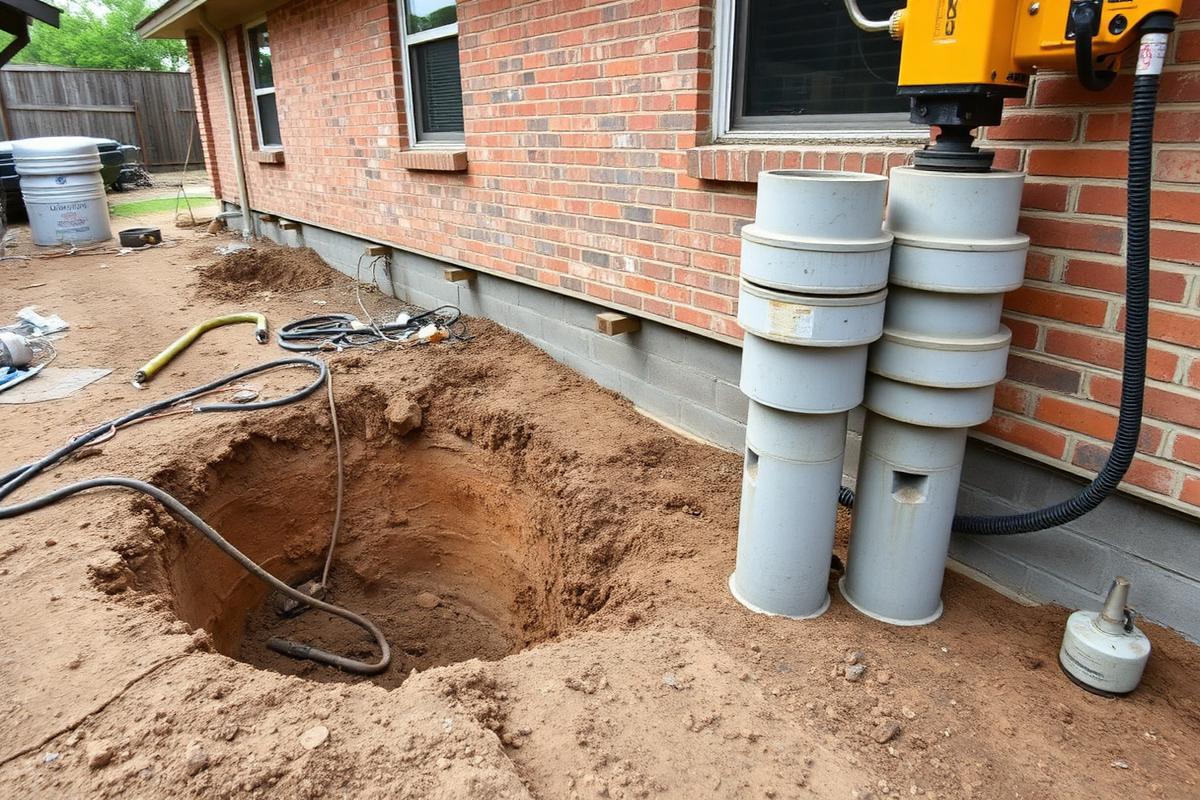
What underpinning does
Underpinning is the general term for extending support beneath an existing foundation. The shallow soil that originally carried a Houston-area house is often the same clay that expands and shrinks with moisture. A pier reaches past that active zone to deeper material and takes a share of the load with it.
Once the pier is bearing, the foundation above can be held at its current elevation or raised toward its original position — see house leveling.
Pressed concrete piers
Precast concrete cylinders are pressed into the ground in sequence using the weight of the structure as reaction, stacking until resistance is adequate. They are widely used for residential slab work across the Houston market, install relatively quickly, and suit many typical perimeter repair conditions.
Steel piers
Steel pipe sections are driven similarly but can generally reach greater depth with a smaller footprint and less excavation spoil. They are a reasonable choice where bearing material is deep, where loads are higher, or where access limits the excavation size.
Other engineered support systems
Helical piers, drilled or bell-bottom piers and interior support systems are also used in this market depending on application. Helical systems can be appropriate for lighter structures and additions; drilled piers appear in some new construction and specialty repair scopes. On pier-and-beam homes, the support conversation is largely about interior piers and girders instead — see that page.
The right system is a function of soil profile, depth to bearing, structural load, access and the repair objective. Any recommendation should follow site measurements, which is the purpose of the free foundation inspection.
Pier count and cost
Pier count is the single largest driver of project cost, followed by pier type and access. A localized corner repair looks very different on an invoice from a full perimeter scope with interior work. Ranges and cost drivers are laid out on the Houston foundation repair cost page.
How installation typically goes
Layout from readings
Pier locations follow the elevation survey and the foundation's load lines.
Excavate and install
Access is opened at each location and pier sections are driven to bearing resistance.
Support or lift
The foundation is supported at its current position or raised in controlled increments.
Backfill and restore
Excavations are closed and the surface restored at the completion of the work.
Foundation pier questions
How deep do foundation piers go?
Depth is determined by where adequate bearing is found, which varies by site. Some locations reach it in the teens of feet; others go considerably deeper. Installation continues until the pier reaches resistance appropriate for the load.
How many piers will my house need?
Count follows the extent of the settled area and the spacing the foundation requires, not the size of the house alone. A single dropped corner may need a handful; a full perimeter scope needs many more.
Are steel piers better than concrete piers?
Neither is universally superior. Steel piers can be driven deeper with less spoil and suit certain load and depth conditions; pressed concrete piers are widely used across this market and perform well in many residential applications. Site conditions decide.
Do piers stop future foundation movement?
Piers stabilize the supported points by transferring load to deeper material. Areas that are not supported can still respond to soil moisture change, which is why drainage and moisture management remain relevant afterward.
Free Foundation Inspection
We will assess whether piers are appropriate for your property.
Piers should follow a finding, not a sales pitch
We measure the house first and recommend a support approach based on what the readings show.